Begin of page section:
Page sections:

  • Go to contents (Accesskey 1)
  • Go to position marker (Accesskey 2)
  • Go to main navigation (Accesskey 3)
  • Go to sub navigation (Accesskey 4)
  • Go to additional information (Accesskey 5)
  • Go to page settings (user/language) (Accesskey 8)
  • Go to search (Accesskey 9)

End of this page section. Go to overview of page sections

Begin of page section:
Page settings:

English en
Deutsch de
Search
Login

End of this page section. Go to overview of page sections

Begin of page section:
Search:

Search for details about Uni Graz
Close

End of this page section. Go to overview of page sections


Search

Begin of page section:
Main navigation:

Page navigation:

  • University

    University
    • About the University
    • Organisation
    • Faculties
    • Library
    • Working at University of Graz
    • Campus
    Developing solutions for the world of tomorrow - that is our mission. Our students and our researchers take on the great challenges of society and carry the knowledge out.
  • Research Profile

    Research Profile
    • Our Expertise
    • Research Questions
    • Research Portal
    • Promoting Research
    • Research Transfer
    • Ethics in Research
    Scientific excellence and the courage to break new ground. Research at the University of Graz creates the foundations for making the future worth living.
  • Studies

    Studies
    • Prospective Students
    • Students
  • Community

    Community
    • International
    • Location
    • Research and Business
    • Alumni
    The University of Graz is a hub for international research and brings together scientists and business experts. Moreover, it fosters the exchange and cooperation in study and teaching.
  • Spotlight
Topics
  • Our digital Advent calendar
  • Sustainable University
  • Researchers answer
  • Work for us
Close menu

End of this page section. Go to overview of page sections

Begin of page section:
You are here:

University of Graz The 7th Faculty News The heat is on
  • For scientists
  • For science enthusiasts
  • About the 7th Faculty
  • Accompanying research
  • Contact and team
  • News
  • Events

End of this page section. Go to overview of page sections

Monday, 07 September 2020

The heat is on

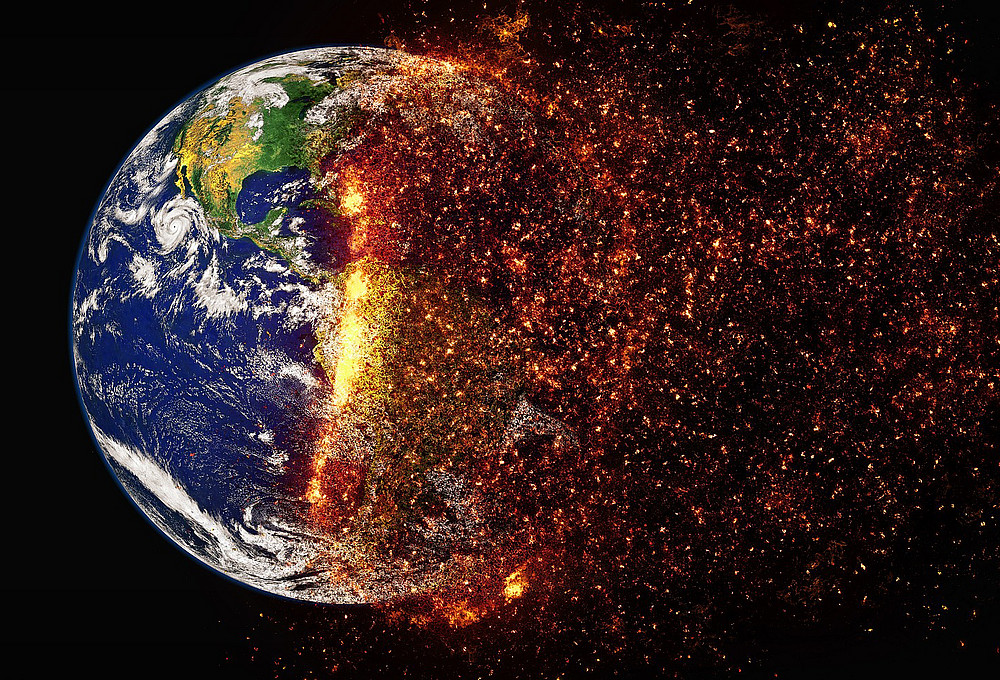
Emissions of greenhouse gases are exacerbating global warming. Photo: pixabay

Emissions of greenhouse gases are exacerbating global warming. Photo: pixabay

Researchers at the University of Graz identify disproportionate global heat gain in the atmosphere

Around the world, emissions of greenhouse gases continue to increase and are exacerbating global warming. A major international study has now completed extensive calculations that show for the first time the extent to which excess heat energy has been accumulating since the 1970s in the Earth’s oceans, landmasses and atmosphere, and causing polar ice shields and glaciers to melt. A team led by Gottfried Kirchengast at the University of Graz’s Wegener Center has been studying the accumulation of heat in the atmosphere. The researchers found that heat in the atmosphere has increased by a surprising rate in the last few decades compared to oceans, land, and the melting ice, contributing also to more severe weather and climate extremes. The findings from the study have just been published in the journal Earth System Science Data.

Growing imbalance
The increasing greenhouse gas concentration in the atmosphere, primarily due to our continuing fossil fuel emissions, is causing an energy imbalance on our planet between the incoming solar radiation and the Earth’s thermal radiation returning to space, which is impeded by greenhouse gases. “We discovered that our Earth meanwhile has to absorb on average about 0.9 joule of excess energy per square meter every second,” explains Kirchengast, summarizing the overall effect. “Since the Earth’s surface area is 510 million square kilometres, that makes a surplus of around 14 trillion gigajoules every year, more than twenty times the world’s energy consumption.” This is dramatically accelerating global warming and climate change, with all the associated consequences. “In the atmosphere the rate of heat increase from 2001 to 2018 was three times as large as the increase over 1971 to 2010 that was published in the last IPCC Assessment Report,” says Kirchengast, referring to the Intergovernmental Panel on Climate Change (IPCC).

Heat inventory
The study was carried out by research teams from ten countries, using the best available data sources on the Earth system. It provides an unprecedented and comprehensive view with up-to-date results showing where the excess energy goes and exerts its effects: around 90 percent is currently stored in the world’s oceans, 5 percent in the land, 3 percent is used in melting ice, and around 2 percent goes into the atmosphere. “Hence the lightweight, gaseous atmosphere only has to absorb the smallest amount in absolute terms, thanks primarily to the oceans acting as heat buffer with their huge water masses. But the relative changes in the atmosphere are the strongest ones and have the most direct impact on us humans, for instance through weather and climate extremes,” Kirchengast sums up. And highlights a central conclusion of the study: “The only way to reduce this dangerous energy imbalance is by drastically reducing our greenhouse gas emissions, in accordance with the Paris climate goals.”

Top international researchers
Kirchengast’s research group is one of the internationally leading groups in the field of atmospheric climate monitoring studies. The team involved in this study included also Max Gorfer and Andrea Steiner from University of Graz, as well as Michael Mayer and Leo Haimberger from the University of Vienna. The researchers based their calculations on the best available data from all over the world, including among others satellite-based radio occultation, high-quality weather balloon radiosondes, and the latest long-term atmospheric reanalysis from the European weather centre ECMWF in Reading/UK.

The international study was conducted in the frame of the Global Climate Observing System and World Climate Research Programmes. The findings will make a substantial contribution to the upcoming IPCC Assessment Report 2021. At the University of Graz this research is part of its Field of Excellence Climate Change Graz.

Publication
Heat stored in the Earth system: where does the energy go? Earth System Science Data, 12, 2013-2041, 7th September 2020
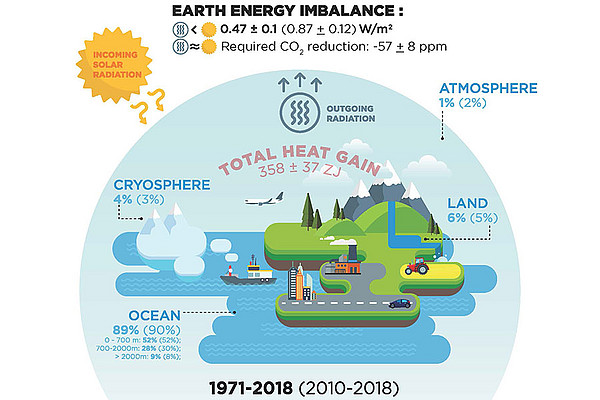
Greenhouse gas emissions caused a heat increase of over 300 trillion gigajoules in the Earth system since the 1970ties. Source: MercatorOcean/ESSD, 2020
created by Gudrun Pichler

Related news

Happy holidays and a wonderful New Year!

The 7th Faculty wishes you a Merry Christmas and a happy New Year. Here you will find an overview of the holiday opening hours of our Hands-on Labs and the university museums.

Extern Intern

From Dinosaurs to Democracy: Reading and Discussion at the Literaturhaus

On Tuesday evening, the Literaturhaus Graz hosted a reading and discussion of the book The Beauty and Elegance of the Austrian Federal Constitution. A Literary Commentary. The venue was filled to capacity, every seat taken, with an attentive and open atmosphere throughout the evening.

“Chemical Life”: University of Graz Christmas Chemistry Show Captivates Audience

Festive spirit met scientific fascination as this year’s edition of the Christmas chemistry show “Chemical Life” transformed the stage of the Schauspielhaus into a lively laboratory. School classes and numerous other guests enjoyed an evening of surprising experiments and vivid insights into the chemistry of everyday life.

Schüler:innen zwischen 10 und 14 Jahren Studierende/Student:innen Wissenschaftskommunikation

Science goes Social II: Recap of a successful workshop series

The lunchtime workshop series “Science goes Social II” brought together three different perspectives on science communication this year. From personal branding to social media strategies, researchers gained valuable insights into how they can make their work and their institutions more visible on social media. The series will continue in 2026.

Wissenschaftler:innen Digitales (Social Media) Workshops Wissenschaftskommunikation

Begin of page section:
Additional information:

University of Graz
Universitaetsplatz 3
8010 Graz
Austria
  • Contact
  • Web Editors
  • Moodle
  • UNIGRAZonline
  • Imprint
  • Data Protection Declaration
  • Accessibility Declaration
Weatherstation
Uni Graz

End of this page section. Go to overview of page sections

End of this page section. Go to overview of page sections

Begin of page section:

End of this page section. Go to overview of page sections