Begin of page section:
Page sections:

  • Go to contents (Accesskey 1)
  • Go to position marker (Accesskey 2)
  • Go to main navigation (Accesskey 3)
  • Go to sub navigation (Accesskey 4)
  • Go to additional information (Accesskey 5)
  • Go to page settings (user/language) (Accesskey 8)
  • Go to search (Accesskey 9)

End of this page section. Go to overview of page sections

Begin of page section:
Page settings:

English en
Deutsch de
Search
Login

End of this page section. Go to overview of page sections

Begin of page section:
Search:

Search for details about Uni Graz
Close

End of this page section. Go to overview of page sections


Search

Begin of page section:
Main navigation:

Page navigation:

  • University

    University
    • About the University
    • Organisation
    • Faculties
    • Library
    • Working at University of Graz
    • Campus
    Developing solutions for the world of tomorrow - that is our mission. Our students and our researchers take on the great challenges of society and carry the knowledge out.
  • Research Profile

    Research Profile
    • Our Expertise
    • Research Questions
    • Research Portal
    • Promoting Research
    • Research Transfer
    • Ethics in Research
    Scientific excellence and the courage to break new ground. Research at the University of Graz creates the foundations for making the future worth living.
  • Studies

    Studies
    • Prospective Students
    • Students
  • Community

    Community
    • International
    • Location
    • Research and Business
    • Alumni
    The University of Graz is a hub for international research and brings together scientists and business experts. Moreover, it fosters the exchange and cooperation in study and teaching.
  • Spotlight
Topics
  • Our digital Advent calendar
  • Sustainable University
  • Researchers answer
  • Work for us
Close menu

End of this page section. Go to overview of page sections

Begin of page section:
You are here:

University of Graz The 7th Faculty News Syrische Süßigkeiten
  • For scientists
  • For science enthusiasts
  • About the 7th Faculty
  • Accompanying research
  • Contact and team
  • News
  • Events

End of this page section. Go to overview of page sections

Thursday, 19 November 2015

Syrische Süßigkeiten

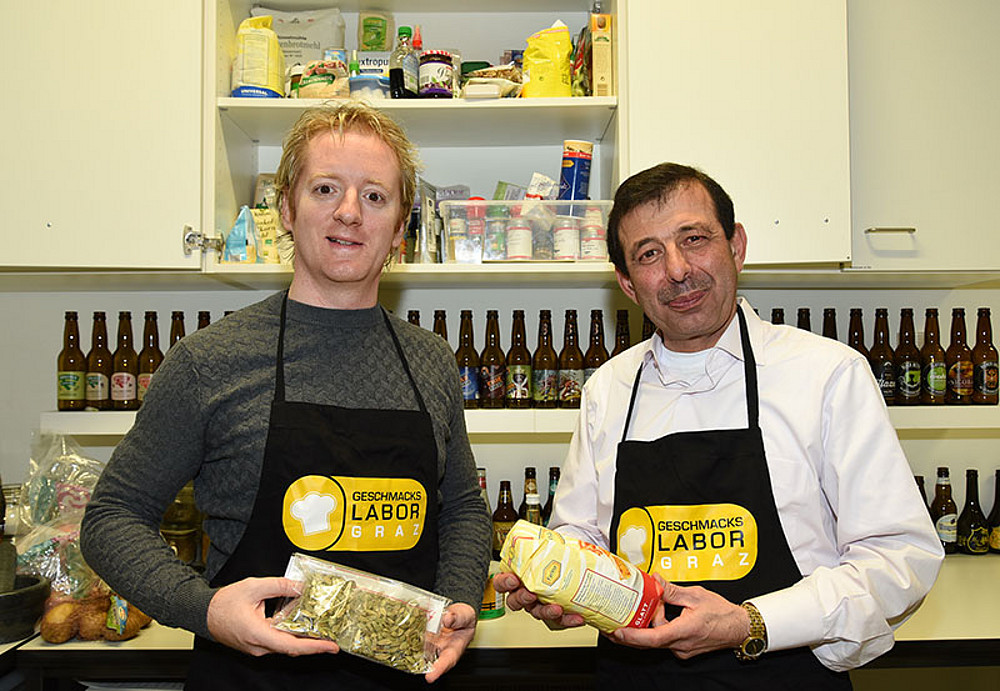
Fritz Treiber (l.) lud Nabil Halawani, dessen Familie seit 1812 eine Süßwarten-Manufaktur in Damaskus betreibt, zu zwei Workshops ins Geschmackslabor der Uni Graz. Foto: Uni Graz/Kastrun.

Fritz Treiber (l.) lud Nabil Halawani, dessen Familie seit 1812 eine Süßwarten-Manufaktur in Damaskus betreibt, zu zwei Workshops ins Geschmackslabor der Uni Graz. Foto: Uni Graz/Kastrun.

Das Geschmackslabor lud den Sohn von Damaskus' berühmtesten Süßigkeiten-Fabrikant zum Kochkurs

Halwa, Orangenkuchen, Milchreis oder syrisches Tiramisu - wem läuft da nicht das Wasser im Mund zusammen? Beim Workshop zur syrischen Koch- und Konditorkunst des Geschmackslabors der Uni Graz stand Traditionelles und Innovations gleichermaßen auf dem Menüplan. Typische Süßspeisen - wie etwa Baklawa, Kunafa oder Halawat Dschib - sowie die syrischen Nationalgerichte Tisqiye, Kibbeh, Warak Inab und Mhamrat hatte Gastkoch Nabil Halawani im Repertoire. Auf Einladung von Dr. Fritz Treiber und Assoz.-Prof. Dr. Helmut Jungwirth begab sich Halawani - seine Familie betreibt seit dem Jahr 1812 eine Süßwaren-Manufaktur in Damaskus - am 17. und am 18. November 2015 mit zahlreichen Workshop-TeilnehmerInnen auf eine schmackhafte Reise in seine Heimat.

Die Einnahmen kommen den Flüchtlingsfonds der Uni Graz zugute. 

Wegen seiner geographischen Lage profitierte Syrien jahrhundertelang von dem Handel, der entlang der Seidenstraße getrieben wurde. Zahlreiche Gewürze und Rezepte wechselten die BesitzerInnen und viele kulinarische Einflüsse prägten das Land seitdem: "Unsere Küche ist beeinflusst von der Türkei, Indien und China, hat aber durch selbstständige Interpretationen der Speisen eine ganz eigenständige Note entwickelt", erzählt Halawani, der für diverse Firmen im Nahen Osten als Konsulent bezüglich Süßwarenherstellung tätig war und in Köln Wirtschaftswissenschaften studiert hat. Nomen est omen - sein Familienname leitet sich nicht von ungefähr von der Süßspeise "Halwa" ab und bedeutet, frei übersetzt, "Konditor." Die Firma, die Halawanis Vater trotz des Krieges weiterhin betreibt, spezialisierte sich auf besondere Feinheiten, wie etwa Lokum aus Mastix.

Halawani lebt bereits seit einiger Zeit in der Türkei und möchte das Geschäft mit den Süßwaren heute nutzen, um zur interkulturellen Vermittlung beizutragen: "Die Sprache ist zwar der wichtigste Schlüssel zu einer Kultur, die Kulinarik ist aber enorm hilfreich. Gutes Essen sorgt nicht nur für zufriedene Gemüter, sondern kann auch den Geist aufnahmewilliger machen. Für gegenseitiges Verständnis und Respekt ist die persönliche Freiheit enorm wichtig." Halawanis Philosophie: "Geben ist Leben. Nur wer andere glücklich macht und sich in einem guten Umfeld befindet, kann seine persönlichen Gedanken ohne Furcht frei äußern. Ein Miteinander der freien Meinungsäußerung ist enorm wichtig für das Zusammenleben von Menschen mit unterschiedlichem Hintergrund."

Halawani hofft, eines Tages nach Syrien zurückzukehren und mit all jenen, die gezwungen waren, dem Land den Rücken zu kehren, die gemeinsame Heimat "mit neuen Gedanken" aufzubauen: "Alle, die flüchten mussten, hatten die unschätzbare Gelegenheit, auf ihrem Weg andere Kulturen kennenzulernen und auf dieser Basis die eigene zu reflektieren. Dieser Austausch wird hoffentlich in naher Zukunft schon ganz wichtig für den Neuaufbau Syriens sein." 


created by Gerhild Kastrun

Related news

Happy holidays and a wonderful New Year!

The 7th Faculty wishes you a Merry Christmas and a happy New Year. Here you will find an overview of the holiday opening hours of our Hands-on Labs and the university museums.

Extern Intern

From Dinosaurs to Democracy: Reading and Discussion at the Literaturhaus

On Tuesday evening, the Literaturhaus Graz hosted a reading and discussion of the book The Beauty and Elegance of the Austrian Federal Constitution. A Literary Commentary. The venue was filled to capacity, every seat taken, with an attentive and open atmosphere throughout the evening.

“Chemical Life”: University of Graz Christmas Chemistry Show Captivates Audience

Festive spirit met scientific fascination as this year’s edition of the Christmas chemistry show “Chemical Life” transformed the stage of the Schauspielhaus into a lively laboratory. School classes and numerous other guests enjoyed an evening of surprising experiments and vivid insights into the chemistry of everyday life.

Schüler:innen zwischen 10 und 14 Jahren Studierende/Student:innen Wissenschaftskommunikation

Science goes Social II: Recap of a successful workshop series

The lunchtime workshop series “Science goes Social II” brought together three different perspectives on science communication this year. From personal branding to social media strategies, researchers gained valuable insights into how they can make their work and their institutions more visible on social media. The series will continue in 2026.

Wissenschaftler:innen Digitales (Social Media) Workshops Wissenschaftskommunikation

Begin of page section:
Additional information:

University of Graz
Universitaetsplatz 3
8010 Graz
Austria
  • Contact
  • Web Editors
  • Moodle
  • UNIGRAZonline
  • Imprint
  • Data Protection Declaration
  • Accessibility Declaration
Weatherstation
Uni Graz

End of this page section. Go to overview of page sections

End of this page section. Go to overview of page sections

Begin of page section:

End of this page section. Go to overview of page sections